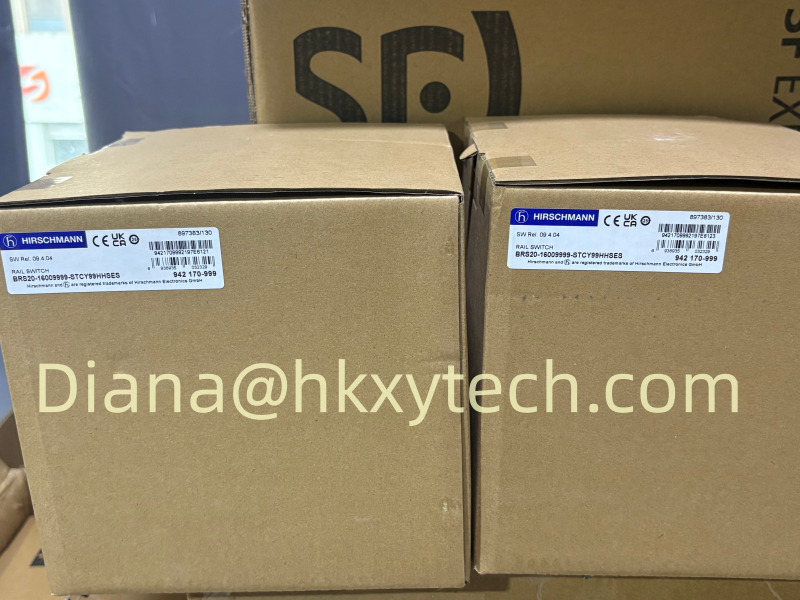
Select the ten-port multimode HL configuration by its complete reference Hirschmann BRS20-1000M2M2-STCX99HHSESXX.X.XX
Hirschmann BRS20-1000M2M2-STCX99HHSESXX.X.XX is the Hirschmann BRS20-8TX/2FX-HL BOBCAT managed DIN rail configuration with 8 10/100BASE-TX RJ45 ports and two fixed 100BASE-FX multimode SC fiber interfaces. The catalog specifies an operating temperature range of 0 to +60 °C. Identify the unit by its complete Product code and part number 942170026 when planning an installation or requesting a repeat order. The interface arrangement, environmental values and documented software functions below define the selection more precisely than a family name alone.
Technical specifications
| Brand | Hirschmann |
|---|---|
| Catalog Type | BRS20-8TX/2FX-HL |
| Product code | BRS20-1000M2M2-STCX99HHSESXX.X.XX |
| Part Number | 942170026 |
| Port Type and Quantity | 10 Ports in total: 8x 10/100BASE TX / RJ45; 2x 100Mbit/s fiber ; 1. Uplink: 1 x 100BASE-FX, MM-SC ; 2. Uplink: 1 x 100BASE-FX, MM-SC |
| Operating Voltage | 2 x 12 VDC ... 24 VDC |
| Power Consumption | 8 W |
| Operating temperature | 0 to +60 °C |
| Housing | PC-ABS |
| Dimensions (WxHxD) | 73 mm x 138 mm x 115 mm |
| Weight | 500 g |
| Mount Type | DIN Rail |
| IP Protection Rating | IP30 |
| Hazardous locations | ISA12.12.01 |
Confirm the operating range before approving a substitute
The standard-temperature HL version is specified from 0 to +60 °C. Its network interfaces comprise eight RJ45 copper ports and two fixed multimode SC fiber ports. An ISA12.12.01 entry appears under hazardous locations in the manufacturer catalog. Keep the actual temperature value in the equipment schedule so an HL requirement is not confused with a requirement for EEC operation. For replacement work, obtain the existing label and record the far-end optical connection. Similar optical connectors do not establish the same fiber type or environmental selection. Check the offered documentation where approval evidence is required, and retain the applicable installation instructions. The inquiry should also identify accessories and the required quantity. These details help the supplier define a precise offer and give the receiving team a clear basis for checking the delivered switch before installation.
Hirschmann product reference image. The pictured model may differ from the specified configuration.
Keep segmentation tied to the application design
The catalog switching functions include VLANs, prioritization and IGMP snooping. Determine how these functions fit the real traffic pattern before assigning settings to individual ports. Document which connections belong to each intended network segment and where traffic must pass between equipment groups. Multicast handling should be tested with the devices that generate and receive that traffic. Save the accepted settings after application testing, and review them when port roles change. This makes the installed configuration easier to maintain than an undocumented collection of settings carried forward from another machine.
Monitoring a copper network across service visits
The management feature list includes HTTPS, SSHv2, SNMP v1/v2/v3 and LLDP, while diagnostics provide copper cable testing, link-speed and duplex monitoring, event logging and port mirroring. Choose which information the maintenance team needs and where it will be retained. A logged event is easier to interpret when port destinations and recent configuration changes are known. HIPER-Ring, MRP and RSTP support planned redundancy arrangements, subject to correct configuration across the network. Acceptance should confirm the selected arrangement rather than simply checking that all link LEDs are illuminated.
Review the supply and mounting arrangement
The manufacturer lists 73 mm x 138 mm x 115 mm enclosure dimensions, 500 g device weight and 8 W power consumption. The supply specification is 2 × 12–24 V DC. Plan the cabinet layout around the DIN rail mounting arrangement, with additional clearance for the connected cables and access to terminals. IP30 is the stated enclosure protection; the surrounding installation must provide the protection required by its environment. Check the supply wiring against the manufacturer instructions and label each connection. Retain the approved power arrangement with the equipment documentation, especially where the maintenance process depends on identifying individual supply sources. Use the exact device weight when reviewing the mounting arrangement.
Prepare a clear replacement inquiry
Use Hirschmann BRS20-1000M2M2-STCX99HHSESXX.X.XX and part number 942170026 as the common reference across the inquiry, quotation and acceptance record. Add the required quantity and provide the existing device label where a unit is being replaced. Describe the required network functions and connection arrangement, and identify accessories as separate supply items. Review the offered scope before release. After installation, retain the accepted configuration and record the actual cable destinations. A complete record helps future service work preserve the intended selection even when several similar switches are used at the same site.
Configuration files belong with the machine documentation
The documented configuration tools include USB-C management support, XML-based configuration files and automatic configuration undo. Remote configuration backup when saving is also listed. Select the backup method used by the site and test the procedure during commissioning. Store the accepted file with the machine reference and the full switch code, and record later authorized changes. A file without a clear device association can be as difficult to use as a missing backup. Identify service accessories separately if the maintenance procedure depends on a particular cable or adapter. Keep a dated record of accepted configuration changes.
Manufacturer reference:
Hirschmann BRS20-8TX/2FX-HL — official configuration details