

Applying ABB TSH210.Y0.A2.N61.M6.Z9.F57.R1.T2.A5.H6-AZ.P5.G9.M5 in demanding high-temperature processes
ABB TSH210.Y0.A2.N61.M6.Z9.F57.R1.T2.A5.H6-AZ.P5.G9.M5 belongs to the SensyTemp TSH200 family of straight thermocouple assemblies for high-temperature measurement. The TSH210 version uses a metal thermowell and is intended for applications where thermal exposure, mechanical loading and the process connection must be considered together rather than treating the sensing element as an isolated component.
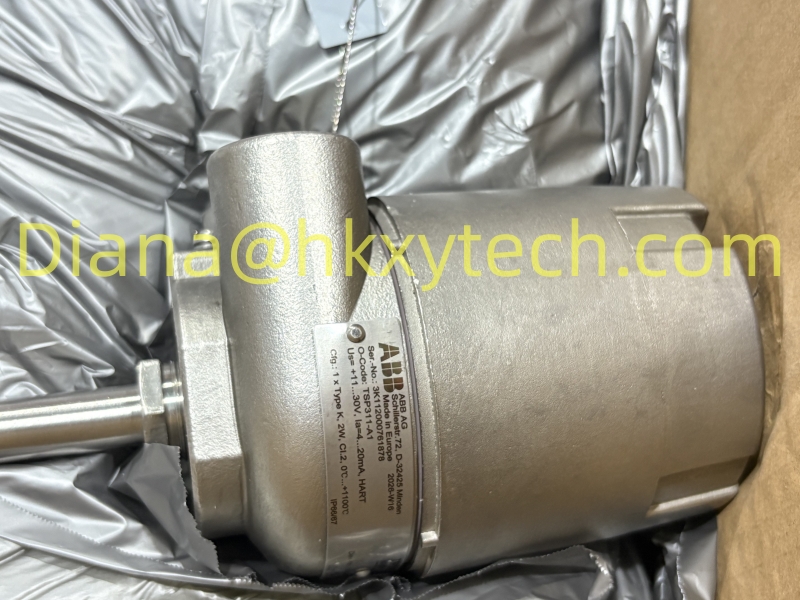
Temperature capability depends on the complete assembly
The ABB TSH210 family is specified for temperatures up to 1300 °C when used with the appropriate thermocouple and metal thermowell. The final allowable temperature for ABB TSH210.Y0.A2.N61.M6.Z9.F57.R1.T2.A5.H6-AZ.P5.G9.M5 must still be checked against the ordered sensor element, thermowell material, insertion arrangement and connection-head configuration. Furnace atmosphere, velocity, vibration and temperature gradients can affect service life even when the nominal temperature is within range.
A longer immersion length may improve representation of the process temperature, yet it also increases bending load on the thermowell. Where horizontal mounting is unavoidable, support and process flow direction deserve particular attention. The sensor should not be forced into alignment after the process connection has been tightened.
Connection head, transmitter and signal route
ABB provides connection-head options and head-mounted transmitter arrangements for the TSH200 family. Depending on the ordered build, the field signal can be a direct thermocouple output or a conditioned signal such as 4–20 mA with a supported communication option. For this full order code, confirm the supplied head, transmitter and electrical entry against the approved datasheet before preparing the wiring diagram.
Keep extension-wire type and polarity consistent with the thermocouple. Route low-level thermocouple wiring away from switching conductors and high-current cables. If a transmitter is installed in the head, document its input type, range, damping and failure behavior. This gives ABB TSH210.Y0.A2.N61.M6.Z9.F57.R1.T2.A5.H6-AZ.P5.G9.M5 a traceable measurement path from the hot process to the control system.
Installation details that protect measurement quality
The TSH210 can be installed with a threaded socket or a stop-flange and counter-flange arrangement. Gas-tightness depends on the exact construction and sealing point. ABB notes that clamping at the metal holding tube does not automatically make the ceramic transition gas-tight. The project should therefore define the required pressure boundary and verify it against the ordered construction instead of assuming that every mounting method provides the same seal.
During receipt inspection, compare the nameplate with ABB TSH210.Y0.A2.N61.M6.Z9.F57.R1.T2.A5.H6-AZ.P5.G9.M5, check the immersion length and process connection, and inspect the thermowell for transport damage. Commissioning should include continuity or transmitter simulation, polarity confirmation and a reasonableness check against a trusted temperature reference. Retain the complete order code because shorter descriptions such as “TSH210” do not identify every mechanical and electrical option.
Manufacturer reference: ABB SensyTemp TSH200 high-temperature thermometer family


