Using the MTL MTL5042 Repeater Power Supply to Preserve 4-20 mA Signal Integrity Between Hazardous-Area Transmitters and Safe-Area Control Systems
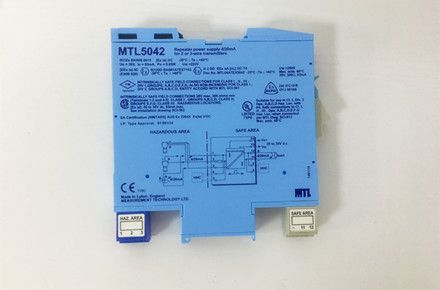
The MTL5042 is a single-channel repeater power supply for conventional two-wire or three-wire 4-20 mA transmitters installed in a hazardous area. It provides a floating DC supply to energize the field transmitter and repeats the measured current into a separate floating safe-area circuit. For compatible smart two-wire transmitters, the MTL5042 also allows bidirectional communication signals to share the analog loop.
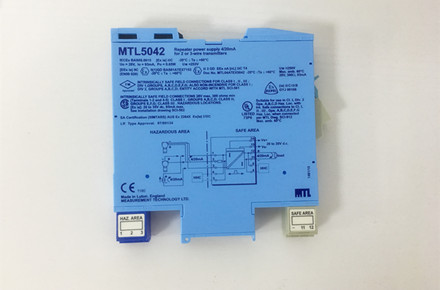
Follow the signal path before checking individual terminals
A practical way to understand the MTL5042 is to trace one complete measurement. The field transmitter senses the process and modulates the loop current. The MTL5042 supplies the transmitter through the intrinsically safe side, receives that current and reproduces it for the safe-area load. The control system then interprets the repeated 4-20 mA value as pressure, level, flow, temperature or another engineering variable.
This signal-path view is useful during fault finding. A low or unstable reading may originate from the transmitter, field cable, barrier supply, safe-area load, grounding arrangement or control-system scaling. Measuring only at the final analog input can hide where the problem begins. Test points and temporary meters should be used only where permitted by the hazardous-area and intrinsic-safety procedure.
Published MTL5042 characteristics provide a clear compatibility baseline
| Characteristic | MTL5042 published value |
|---|---|
| Channels | One |
| Safe-area signal range | 4 to 20 mA, with 0 to 24 mA under-range and over-range |
| Safe-area load | 0 to 600 ohm |
| Transmitter voltage | 16.5 V at 20 mA |
| Module supply | 20 to 35 V DC |
| Supported smart protocols | Includes HART, Honeywell DE, Foxboro and Yokogawa Brain according to the datasheet |
These values are useful for engineering checks, but they do not replace the entity-parameter review for the complete intrinsically safe loop. The transmitter certification, cable capacitance and inductance, MTL5042 safety parameters and hazardous-area classification must be evaluated together by competent personnel. The applicable certificate version and local installation standard should be identified in the project file.
Loop drawings should make power, polarity and communication access unambiguous
The MTL5042 datasheet identifies separate terminals for transmitter current input, transmitter supply, safe-area output and module supply. Wiring should be completed from the current instruction manual and the approved loop drawing. Terminal numbers should not be copied from another isolator simply because the housings look similar. Polarity, optional hand-held communicator connections and cable screen treatment should be checked before power is applied.
During commissioning, the technician can compare a known field current with the MTL5042 safe-area output and the DCS indication. Useful test points include approximately 4 mA, a midrange value and approximately 20 mA, plus under-range or alarm behavior when the system specification requires it. Communication should be tested from the intended access point if smart protocol use is part of the design.
Legacy status makes documentation and migration planning especially important
Eaton and MTL support information identifies the MTL5042 as an obsolete MTL5000-series product and lists MTL5500-family migration guidance. A replacement should not be selected only from a cross-reference table. Channel function, transmitter type, supply, output load, communication direction, intrinsic-safety parameters, terminal arrangement and approvals all need comparison.
For an installed MTL5042, the maintenance file should retain the exact model, certificate references, loop drawing, cabinet position and commissioning results. A planned migration can then be reviewed before an outage rather than during a failure. The MTL5042 remains a clearly defined repeater power supply, and careful signal-path verification allows plants to maintain dependable 4-20 mA measurement while managing legacy equipment responsibly.