
Hygienic-Ready E+H PMP23-4RN0 Cerabar Compact Pressure Transmitter for Reliable Food, Beverage, Water and Process Utility Measurement
 August
14, 2026
August
14, 2026
Applying the E+H PMP23-4RN0 Cerabar in Hygienic Pressure Systems: Selection, Installation, Cleaning and Commissioning Decisions
The E+H PMP23-4RN0 is a compact Cerabar pressure transmitter intended for dependable pressure measurement where space, cleanability and straightforward loop integration matter. The supplied product image identifies this specific unit as a Cerabar with a 0 to 10 bar absolute measuring range and a 4-20 mA output. Those nameplate details make the E+H PMP23-4RN0 a practical candidate for engineering teams that need a clearly documented instrument for tanks, skids, utility lines and hygienic process equipment.
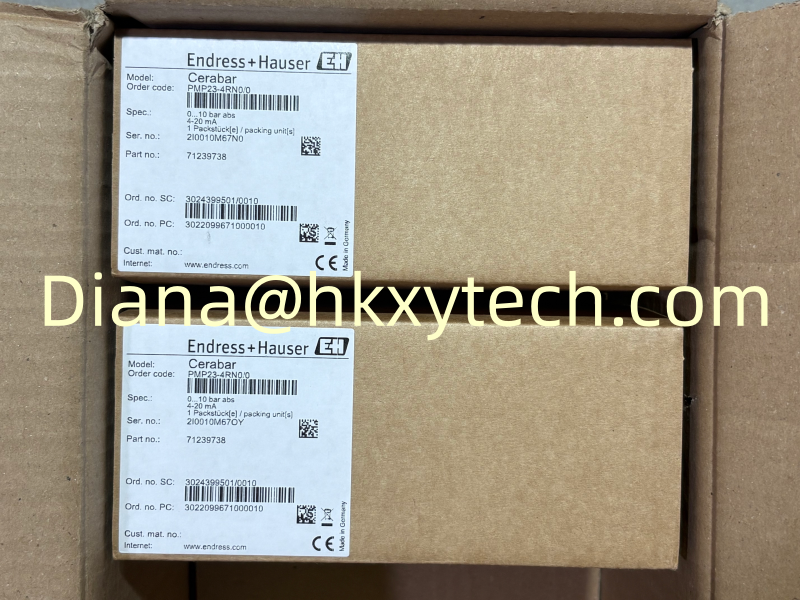
What the Supplied Unit Confirms
Product family: Cerabar PMP23 compact pressure transmitter.
Order code: E+H PMP23-4RN0 as shown on the package label.
Calibrated range: 0 to 10 bar absolute pressure.
Signal: 4-20 mA for direct connection to a control or monitoring loop.
Quantity and traceability: the label provides individual serial and order references for receiving inspection.
These confirmed details should lead the project record. The wider PMP23 family can be supplied with different ranges, process connections, approvals and communication choices, so engineers should not assume that every catalog option is included in the E+H PMP23-4RN0. The safest practice is to match the carton label, instrument nameplate, order documentation and required certificates before installation.
Where the Instrument Fits
In a beverage or food plant, the E+H PMP23-4RN0 can support pressure monitoring on clean utility skids, supply lines, product handling equipment or compact vessels when the process range and connection match the application. In water treatment, the same 0 to 10 bar absolute span can suit pump discharge, filtration or packaged treatment duties after the engineer checks static pressure, surge pressure and the required pressure reference. For machine builders, the compact form of the E+H PMP23-4RN0 helps reduce panel and piping complexity on modular equipment.
Absolute pressure is referenced to an internal vacuum rather than local atmospheric pressure. This distinction is important. A control strategy developed around gauge pressure may show an offset if an absolute transmitter is substituted without updating scaling and alarm logic. Before selecting the E+H PMP23-4RN0, confirm that the process calculation, operator display and PLC engineering units all expect absolute pressure.
Five Questions Before Installation
Is 0 to 10 bar absolute the correct span? Compare normal operating pressure, vacuum conditions, cleaning pressure and credible upset pressure with the range printed on the E+H PMP23-4RN0 label.
Does the process connection match? Confirm the exact connection in the full order record and verify compatibility with the vessel nozzle or pipe adapter. Avoid adding unnecessary pockets where residue can collect.
Is the wetted material suitable? The PMP23 family uses a flush-mounted metallic measuring diaphragm for hygienic service, but chemical compatibility must still be checked against the actual product, detergent and sanitizing agent.
Is the installation location cleanable? Position the E+H PMP23-4RN0 so the sensing face can drain and the cable connection is protected from repeated washdown stress.
Is the loop design correct? Verify DC supply, load resistance, polarity, cable routing, grounding practice and the analog input configuration before energizing the E+H PMP23-4RN0.
Hygienic Installation: Do and Avoid
Do: inspect the sealing surface, use the specified hygienic seal, tighten the connection according to the applicable procedure, and keep the flush diaphragm free from mechanical contact. Mount the E+H PMP23-4RN0 in an orientation that supports drainage and easy visual inspection. Record the serial number and installation point before the line becomes inaccessible.
Avoid: using the housing as a lever, touching the diaphragm with tools, creating a dead leg, trapping gas in a liquid pressure point, or allowing a heavy cable to pull on the connector. Do not pressure-test beyond the permitted limits simply because the broader PMP23 family lists higher ranges. The installed E+H PMP23-4RN0 must be protected according to its own ordered range and documentation.
A Commissioning Record That Proves the Loop
Start with a visual and documentation check. Confirm that E+H PMP23-4RN0 appears consistently on the receiving record, calibration record, instrument index and PLC tag sheet. Next, verify the loop supply with the transmitter connected and confirm that the 4-20 mA signal is stable. Apply at least three known pressure points across the working span, including a rising and falling sequence, and compare the field value with the control-system display.
Then challenge the alarm and interlock thresholds that depend on the E+H PMP23-4RN0. A transmitter can be accurate while the system remains wrong because of incorrect absolute-versus-gauge scaling, mismatched engineering units or a reversed range. Save the as-left readings, test equipment identification and acceptance limits so future technicians can distinguish process change from instrument drift.
Cleaning and Lifecycle Control
Endress+Hauser lists the PMP23 family for hygienic applications and notes a standard process temperature range of -10 to +100 degrees C, with exposure to +135 degrees C for a maximum of one hour in applicable configurations. The manufacturer also lists hygienic connections and approvals as configuration-dependent options. For the E+H PMP23-4RN0, confirm the full order code and certificates before defining CIP or SIP limits; do not treat family-level maximums as automatic approval for every installed unit.
During maintenance, inspect the cable seal, process seal, diaphragm condition and evidence of moisture ingress. Compare current readings with the commissioning baseline instead of replacing the E+H PMP23-4RN0 solely because a process value moved. If removal is required, isolate and depressurize the line, protect the sensing face, and retain the serial-number link between the instrument and its calibration history.
Procurement and Replacement Checklist
State the complete E+H PMP23-4RN0 order code and required quantity.
Confirm the 0 to 10 bar absolute range and 4-20 mA output from the supplied label.
Verify process connection, electrical connector, seal material and ingress protection.
Request any hygienic, material or calibration documents required by the quality system.
Compare the replacement E+H PMP23-4RN0 with the installed nameplate before changing PLC scaling.
The value of the E+H PMP23-4RN0 is not only its compact construction. Its real contribution comes from correct range selection, hygienic mechanical installation, disciplined 4-20 mA commissioning and traceable maintenance. When those decisions are documented, the E+H PMP23-4RN0 can provide a clear and maintainable pressure signal for modern process skids and hygienic production systems.