
Responsive and Versatile FLK 971 Temperature Humidity Meter with Dew Point Wet Bulb and 99-Record Storage for HVAC Diagnostics
 August
06, 2026
August
06, 2026
Improving HVAC and Indoor Air Quality Assessments with the FLK 971 Temperature Humidity Meter: A Detailed Guide to Measurement, Interpretation and Field Documentation
The FLK 971 combines temperature and relative humidity measurement in a compact handheld instrument for HVAC service, facility maintenance, indoor air quality investigation and environmental monitoring. Its dual display allows both readings to be viewed together, helping technicians understand moisture conditions rather than treating temperature and humidity as unrelated values.
In addition to direct temperature and relative humidity, the FLK 971 calculates dew point and wet-bulb temperature. These derived values support condensation-risk checks, ventilation assessment, comfort investigations, drying verification and comparison between supply air, return air, outdoor air and occupied spaces.
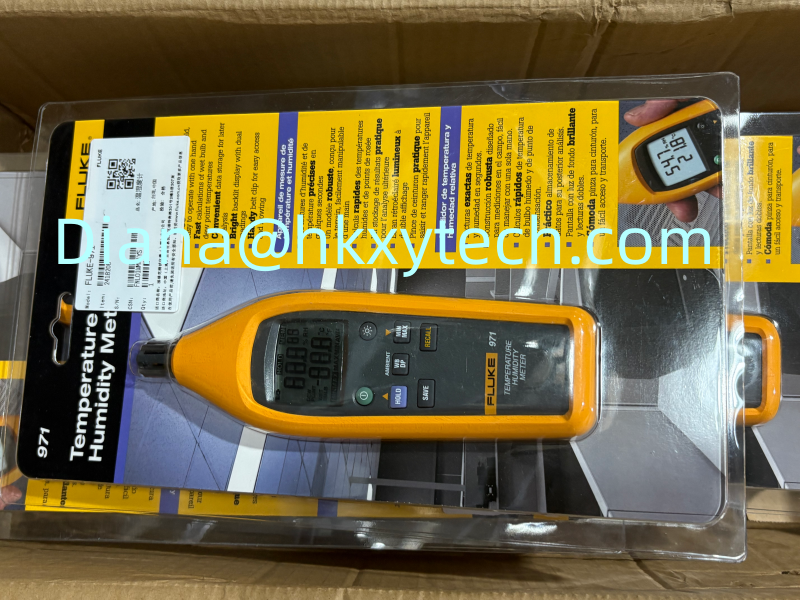
Understanding the Four Main FLK 971 Readings
Shows the sensible temperature measured by the FLK 971 NTC sensor and provides context for humidity and comfort conditions.
Indicates the percentage of moisture in the air relative to the maximum amount the air can hold at the same temperature.
Estimates the temperature at which condensation begins, helping the FLK 971 support surface-moisture and mold-risk investigations.
Supports evaporative-cooling, air-treatment and HVAC performance assessments by linking heat and moisture behavior.
Technical Data in a Compact Format
Brand and model: FLK 971 Temperature Humidity Meter
Temperature range: -20 to +60 degrees C
Temperature accuracy: +/-0.5 degrees C from 0 to 45 degrees C; +/-1.0 degrees C outside that range
Temperature resolution and update: 0.1 degrees C / 0.1 degrees F and 500 ms
Relative humidity range: 5% to 95% RH
Relative humidity accuracy: +/-2.5% RH from 10% to 90% RH at 23 degrees C; +/-5.0% RH outside that band
Humidity response: 60 seconds for 90% of the total range with 1 m/s air movement
Data storage: 99 points with Min, Max, Avg and Data Hold functions
Dimensions and weight: 194 x 60 x 34 mm; approximately 190 g
Power: Four AAA alkaline batteries with up to 200 hours of battery life
A Reliable Field Measurement Routine
Plan the comparison points. Identify outdoor air, supply air, return air, occupied zones, suspected damp locations and reference areas before using the FLK 971.
Allow the sensor to stabilize. After moving between environments, give the FLK 971 enough time to respond before recording a value.
Avoid local interference. Keep the FLK 971 away from direct breath, wet hands, sunlight, hot equipment and surfaces that do not represent room air.
Record location and time. Store readings with clear point identification so the FLK 971 data can be compared across zones and visits.
Interpret patterns, not isolated numbers. Compare temperature, RH, dew point and wet-bulb readings with HVAC operation, occupancy and weather conditions.
HVAC Diagnostics with the FLK 971
In an air-handling system, the FLK 971 can compare return, mixed, supply and room-air conditions. A supply-air reading with insufficient cooling or moisture removal may indicate control settings, coil performance, airflow or system-capacity issues. The meter provides evidence for investigation, but airflow, pressure and equipment measurements are also required for a complete diagnosis.
Wet-bulb and dew-point values help technicians evaluate whether the system is removing moisture effectively. When the FLK 971 shows a high dew point downstream of a cooling process, inspect coil temperature, condensate drainage, bypass air, outside-air load and operating schedule.
The FLK 971 also supports comfort complaints. Comparing multiple occupied zones can reveal whether a problem is local or building-wide. Record thermostat set point, occupancy, supply-air condition and outdoor weather so the temperature-humidity pattern can be interpreted accurately.
Indoor Air Quality and Moisture Investigations
Relative humidity influences comfort, static electricity, material behavior and biological growth. The FLK 971 can help identify consistently humid areas, but a short reading should not be treated as proof of a long-term condition. Use repeated measurements or longer-term data logging when the environment changes through the day.
Dew point is particularly useful when assessing condensation risk. Compare the FLK 971 dew-point reading with the temperature of windows, pipes, walls or ductwork. If a surface is at or below the air dew point, condensation can form even when the room temperature appears comfortable.
For suspected moisture damage, combine FLK 971 readings with surface-temperature measurement, moisture-meter checks and visual inspection. High humidity may explain a risk condition, while hidden leaks, poor drainage or cold bridging may be the underlying cause.
Using Stored Records, Min, Max and Average
The FLK 971 stores up to 99 readings, allowing a technician to complete a room-by-room survey without writing every value immediately. A consistent numbering plan is important: match each stored record to a room, grille, process point or inspection note before leaving the site.
Minimum, maximum and average functions help summarize changing conditions at a point. When the FLK 971 is held in a moving air stream, these functions can show the observed range, but the user should still wait for a stable response and avoid treating a brief transient as the normal condition.
Common Measurement Errors to Avoid
Do not grip or cover the FLK 971 sensor area, because body heat and moisture can disturb the reading.
Do not record immediately after moving the FLK 971 from a cold vehicle into a warm humid room; allow stabilization first.
Do not place the FLK 971 directly in condensate, liquid spray or contaminants that can damage or coat the humidity sensor.
Do not compare readings taken at different heights or airflow conditions without documenting those differences.
Do not interpret RH without temperature, because the same moisture content produces different relative humidity as temperature changes.
Care, Verification and Calibration Planning
Protect the FLK 971 sensor from dust, oil, chemicals and physical impact. Store the meter in a clean case, remove batteries for extended storage and replace weak batteries before a scheduled survey. A contaminated humidity sensor may respond slowly or display biased values even when the instrument powers on normally.
Periodically compare the FLK 971 with a known reference or include it in the site's calibration program. The appropriate interval depends on usage, environmental exposure, quality requirements and the consequences of an incorrect measurement. Record calibration status in field reports when readings support compliance or critical decisions.
Ordering and Application Review
Before ordering an FLK 971, confirm whether the standard meter or a version supplied with traceable calibration data is required. Also review the temperature and humidity ranges, expected operating environment, reporting requirements and accessory needs.
For availability or a quotation, provide the FLK 971 model, calibration requirement, destination and intended HVAC or environmental application. These details help confirm that the selected FLK 971 package supports the planned measurement and documentation process.